
Why One-Size-Fits-All Insurance Advice Fails First-Generation Wealth Builders

[TL/DR] For most first-generation wealth builders in Canada, life insurance should be viewed as a risk shield. It protects your future earning potential while you build your stack. It is not a magic investment engine. When marketed as a "wealth hack," permanent insurance often brings high fees and structural illiquidity. This guide outlines the protection hierarchy you actually need to secure your family's momentum without the hype.
The Allure of the “Wealth Hack”
If you are a high-earning professional or business owner, your social media feed is likely flooded with a specific pitch. Salespeople often branded as "wealth strategists” making bold claims about how the ultra-wealthy use permanent life insurance for wealth building, retirement funds and tax purposes.
For a first-generation builder, this pitch triggers a powerful psychological hook. You are carrying the mental load of protecting your household, you might be supporting aging parents and you want to give your children the head start you never had.
When someone offers an all-in-one "secret" that solves every need at once, it is easy to buy in. But the data from the Financial Services Regulatory Authority of Ontario (FSRA) tells a different story. In a recent review, FSRA found that 80% of reviewed files did not show that these complex policies actually fit the client's needs. The "needs analysis" was often described as trivial or flawed.
In reality, jumping into a complex policy early in your journey is a dangerous distraction. It diverts critical capital away from foundational wealth accumulation.
Permanent Insurance Isn't Bad. It's Usually Premature.
Let's clear the air: permanent life insurance is not a bad product, but it’s a tool designed for a highly specific problem: wealth preservation, not wealth accumulation.
The mistake most first-generation builders make is using this tool before it is needed. If you are in your 30s or 40s, your primary goal is to grow your business, build your investment portfolio, and secure your family's security.
Using permanent insurance as an investment vehicle at this stage is like trying to install a commercial-grade security vault in a house that hasn't had its foundation poured yet.
Our philosophy is simple: we don't beat up on insurance products, we simply believe in using the right tool at the right time.
For a builder, your capital needs to remain highly liquid, flexible, and active.
The Wealth Builders Protection Framework
To secure your family’s momentum without killing your wealth accumulation, you need a coordinated protection hierarchy. This framework separates your protection needs from your investment strategies.
Before worrying about advanced tax strategies, your financial foundation should be built in a strategic order. Every layer supports the one above it.
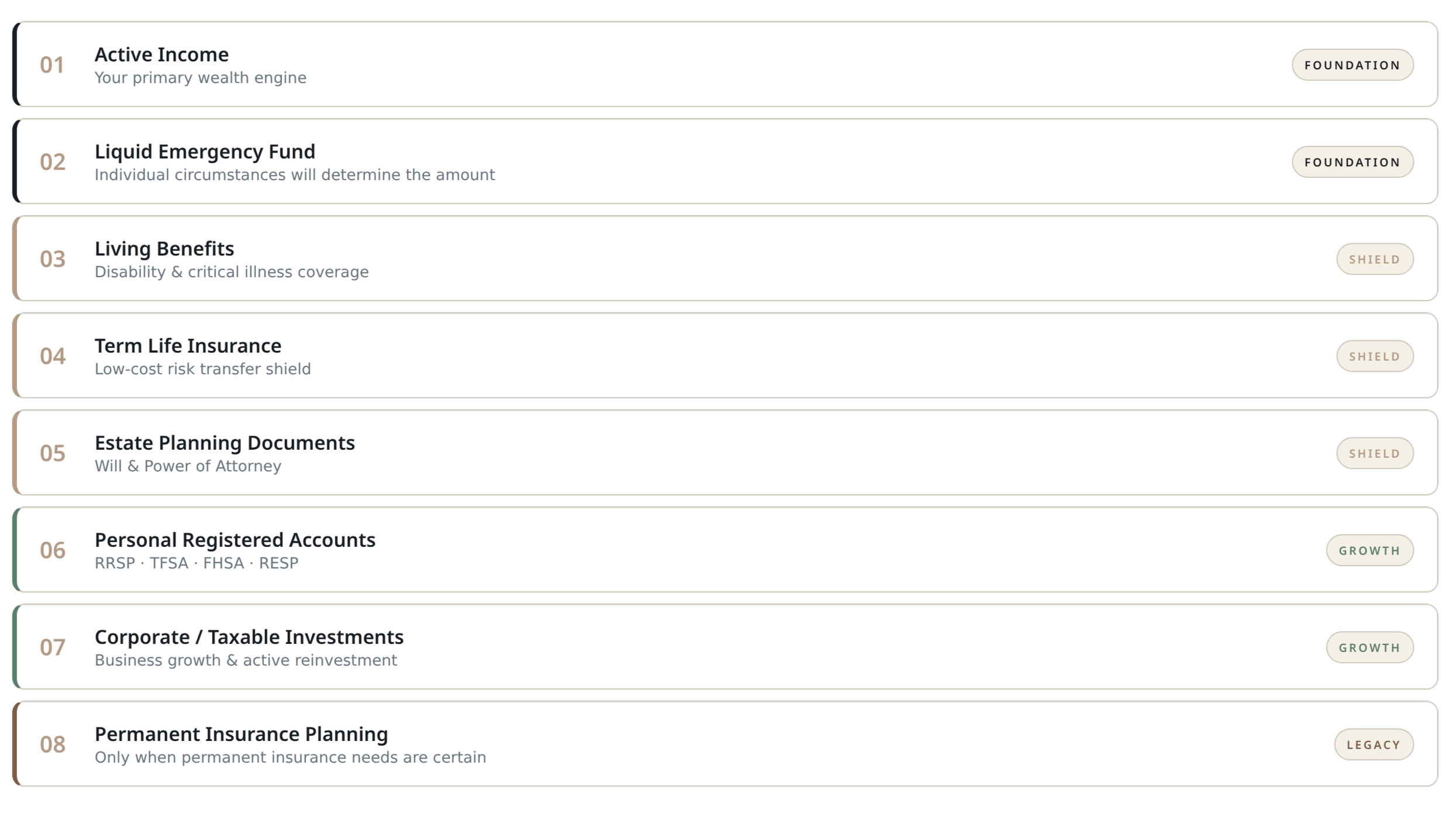
How The Layers Connect:
Your active income funds your emergency reserve.
Your emergency reserve protects your growing assets.
Your insurance shields your income, assets & human capital from medical emergencies or early death.
Your estate documents secure legal control over those protected assets.
Your investments build your long-term wealth.
Your estate plan eventually preserves that wealth for the next generation.
Why Permanent Insurance Usually Comes Later
Pushing permanent insurance to the end of your financial hierarchy is a matter of optimization. As a first-generation wealth builder these are three reasons why these structures are typically reserved for later in your journey:
The Opportunity Cost of Capital: Sinking thousands of dollars every year into an illiquid policy locks up active capital. In your 30s or 40s, that cash yields far greater long-term value when reinvested directly into your operating business, real estate, or compounding in low-cost index funds.
The Ability to Afford the Premium: Because permanent insurance is designed to fund an event that is guaranteed to happen eventually, the premiums are exceptionally high. This often forces first-gen builders into a dangerous trap: buying a tiny permanent death benefit instead of the term coverage their families actually need today for the sake of "investing in insurance."
The Absence of a Permanent Need: Permanent insurance is designed for permanent liabilities that are guaranteed to exist when you pass away. In your 30s and 40s, your liabilities, like mortgages, personal debts, and funding your children's education, are temporary. Buying a permanent tool to solve a temporary risk is a structural mismatch.
When Does Permanent Life Insurance Make Sense?
Once you have progressed through the hierarchy, permanent insurance transitions from an expensive mismatch to a specialized, powerhouse preservation tool.
It works when you have built significant wealth and need to optimize for the tax exit. There are three key scenarios where the math makes sense:
The Corporate Passive Income Trap: If your operating or holding company is highly successful, passive investment income is taxed at roughly 50% in most Canadian provinces. A corporately owned policy can help shelter this cash, and upon your death, all or most the death benefit will flow to your heirs tax-free through the Capital Dividend Account (CDA).
Estate Equalization: If you own a family business that one child runs, you can use a permanent policy to provide a tax-free payout to your other children, equalizing their inheritance without forcing a sale of the company.
Illiquid Family Assets: If you own a family cottage with decades of massive capital gains, your heirs will face a massive tax bill upon your passing. Permanent insurance guarantees a tax-free payout exactly when the bill comes due, preventing a forced sale of the property.
Red Flags: How to Spot Poor Insurance Advice
If you are speaking with an agent, be on high alert for these common sales pitches:
The "Tax-Free Retirement Stream": This is a half-truth. They rarely explain that to access this cash tax-free, you must take out policy collateral loans that accumulate interest and can trigger massive tax bills if the policy eventually collapses.
RRSP Shaming: If an agent calls the RRSP a scam, you can end the call right there.
"Be Your Own Bank" / Infinite Banking: If they show you illustrations assuming guaranteed, high-growth returns while completely ignoring the interest costs of borrowing your own money, they are hiding the structural risks.
A Focus on Recruitment: If they spend more time explaining how you can recruit other agents to sell these policies than explaining the actual actuarial nuances of your contract, you are dealing with an MLM, not a financial planner.
Frequently Asked Questions (FAQ)
Can I start with term insurance and convert it to permanent later?
Yes, almost all high-quality term policies in Canada include a contractual option called "Guaranteed Convertibility."
This allows you to convert all or a portion of your low-cost term policy into a permanent policy in the future without undergoing a new medical exam, answering health questions, or taking blood tests.
This is an exceptionally powerful safety net. You can lock in maximum low-cost protection now while your debts are high, and retain the legal right to transition to a permanent tax-preservation tool later, even if your health changes in the meantime.
Why do I need both Disability and Critical Illness insurance? Don't they cover the same thing?
No, while there are events where both policies may pay out simultaneously they solve different financial crises.
Disability insurance replaces your ongoing monthly income if you cannot work due to an injury or illness, acting as an income replacement stream.
Critical Illness insurance pays a single, tax-free lump sum if you survive a life-altering medical diagnosis, like cancer, a stroke, or a heart attack.
Should I name my Estate as the beneficiary of my policy?
In most cases, no. Naming your estate as the beneficiary subjects the insurance payout to provincial probate fees and exposes your family's safety net to potential estate creditors. Naming a specific individual or a trust allows the death benefit to bypass probate entirely and flow directly to your loved ones as a tax-free lump sum, often within weeks.
When does permanent life insurance actually make sense?
Generally, this should only be considered once you have maxed out your traditional tax shelters and/or you have a permanent insurance need. It is an estate preservation tool, not an initial wealth-builder. It is highly effective for sheltering corporate passive income and transitioning corporate assets to heirs tax-free through the Capital Dividend Account (CDA).
Disclaimer: Tax laws, corporate structures, and insurance guidelines in Canada are highly specialized and subject to change. The strategies outlined in this article are for educational and planning purposes. To build a custom plan that fits your family and business consult with your Financial Planner, insurance advisor and tax/legal team.
Ready to Build Your Financial Plan?
