
Are You Taking Risk You Don't Actually Need?

[TL/DR] After moving past cash stashing and getting their money to work for them, first-generation wealth builders often fall into the opposite trap: taking on aggressive or speculative risks their financial plan does not require. This article explores why first-gen earners fall into the habit of taking on outsized risk in the first place, and provides a framework to evaluate investments through your risk appetite, risk capacity, and actual risk need.
From Cash Stashing to Unnecessary Risk
In last month's article, we explored how first-generation wealth builders can sometimes hold onto too much cash because cash creates a perception of safety.
The problem is that excessive cash comes with its own hidden risks: inflation, tax drag, and the opportunity cost of keeping too much capital on the sidelines.
Once you become comfortable putting your money to work, the opposite trap can emerge:
Taking on more risk than your financial plan actually requires.
This can look different for everyone:
Holding a portfolio filled with speculative investments.
Investing heavily in illiquid private credit.
Funding a friend or family member's startup as seed capital.
Buying real estate when cash flow is already tight.
To be clear, none of these investments are inherently bad. I'm not here to shame you for venturing away from the traditional ETF portfolio.
The real question is whether the risk makes sense within the context of your entire financial picture:
What are the actual risks?
What are the terms and liquidity constraints?
How much could you realistically lose?
Most importantly: What happens to your financial plan if things don't go as expected?
The goal is to make sure the risks you're taking are measured, intentional, and don't compromise what you've spent so much time building.
Sizing the Risk
Consider two scenarios:
Scenario A: You give a friend $50K to help fund their startup. If that represents 50% of your net worth, that single decision could have a significant impact on your financial security if the venture fails.
Scenario B: You give that same $50K to a friend's startup when you have a fully funded emergency reserve & multiple six figures in liquid investments. If it fails, it still stings however your daily life and long-term financial goals remain largely unchanged.
The investment risk is identical. Your financial context is completely different.
The same principle applies to speculative stocks, private investments, real estate, or other opportunities that may come your way.
The question isn't simply:
“Can this investment make money?”
The far more important question is:
“What happens to my financial plan if it doesn't?”
The Noise, the FOMO, and the First-Gen Mindset
For first-generation wealth builders, there can be a lot pulling your attention toward higher-risk opportunities:
Social Media Noise: Our feeds are full of self-proclaimed experts explaining how they made millions through a single speculative strategy.
Peer Pressure & FOMO: We hear what colleagues, friends, or family members are doing and feel like we're falling behind if we're not chasing the same returns.
Learned Financial Behaviors: Many of us grew up in households where financial progress was tied to working harder, pursuing opportunities, and finding ways to build something for the family.
Together, these pressures can cause us to discount proven, systematic wealth-building strategies while overestimating the legitimacy of unvetted “opportunities” brought our way.
Taking a measured approach and letting compound growth work over decades can feel unnaturally slow.
However, recognizing that you don't need to chase every opportunity is one of the highest-leverage mental shifts you can make.
Accounting for the Risks Already Embedded in Your Life
Your investments are only one of the layers of risk that you carry.
There are already significant risks embedded in the structure of your everyday life:
Your Career or Business: Your income may already be heavily concentrated in a single employer, industry, business, or client base.
Your Ability to Earn: Your future income depends on your ability to continue working. Disability, illness, or a major career disruption can have a much larger long-term impact than a temporary market downturn.
Your Family Responsibilities: Many first-generation wealth builders also become part of the financial safety net for parents, siblings, or extended family.
These risks don't show up on an investment statement, but they matter when determining how much additional investment risk your overall financial plan can support.
If your income, business, and family responsibilities already expose you to significant financial uncertainty, that should be part of the conversation before adding concentrated or speculative investments to your portfolio.
Your investments don't need to compete with the risks already present in your life.
The Shift: Aligning Risk Appetite, Capacity and Need
Your relationship with risk shouldn't stay static.
As your income grows and your balance sheet evolves, the role of risk can change too. Early in your wealth-building journey, growth and accumulation may be the priority. As your financial position strengthens, the focus can shift toward optimizing and protecting what you've built.
To determine if an investment risk is necessary, evaluate it through three distinct lenses:
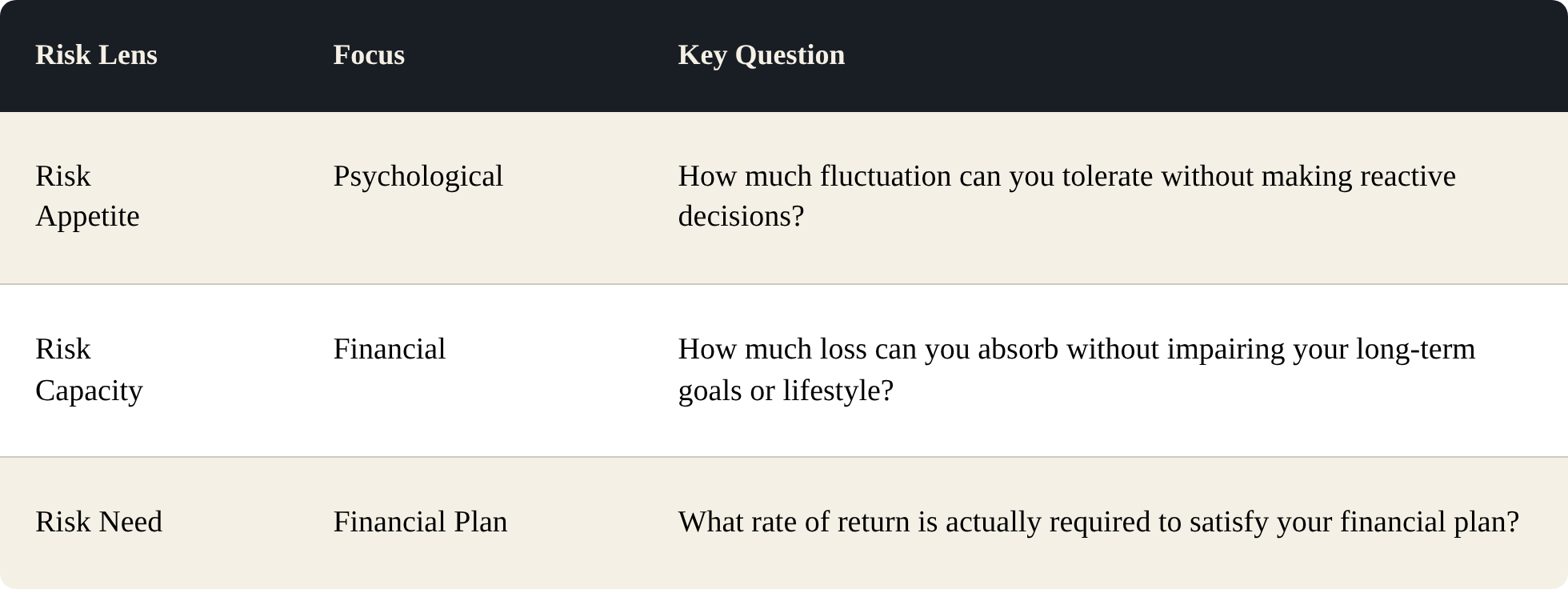
Understanding the Three Lenses
Risk Appetite: It's easy to feel comfortable with risk when markets are rising. Your true appetite is revealed during drawdowns, such as a 30% decline in portfolio value.
Risk Capacity: Your financial capacity to absorb losses depends on your assets, income, obligations, liquidity, and time horizon. Having a larger balance sheet may increase your capacity for loss, but family responsibilities, business concentration, or other obligations can change the equation.
Risk Need: This is where the financial plan brings clarity. If your savings rate, income, and existing asset base already put your long-term milestones on track, chasing speculative returns may simply add volatility without solving a specific problem.
A Diagnostic Audit for Your Balance Sheet
As your financial trajectory evolves, run major financial decisions through these four questions:
What job is this performing?
Is this investment filling a clear gap in my plan, or am I chasing returns because I'm still operating with an early-career hustle mindset?
If this capital goes to zero, what changes in my life?
If the answer is “nothing,” the investment may be a calculated risk that fits within your broader plan.
If the answer is “it delays retirement, affects my family's security, or creates significant financial stress,” it deserves much more scrutiny.
Am I factoring in my embedded life risks?
How much risk am I already carrying through my career, business, income variability, family responsibilities, and other obligations?
Is my financial structure working as hard as my investment strategy?
Am I taking additional market risk to chase returns when better tax planning, account optimization, corporate structuring, or fee management could improve the outcome without increasing portfolio risk?
Sometimes the answer isn't a higher-return investment.
It's a better financial structure.
Alignment Over Aggression
Building long-term wealth doesn’t require you to be the most aggressive investor in the room.
It does require a financial system that reflects your goals, your circumstances, and the life you're trying to build.
Sometimes that means taking more risk because your financial plan requires it.
Other times, it means recognizing that you already have enough risk in your career, business, family responsibilities, and balance sheet.
You've worked hard to move past the fear that kept your money sitting on the sidelines. But putting your capital to work doesn't mean every opportunity deserves a place in your plan.
The goal isn't to eliminate risk.
It's to make sure the risks you take are intentional, appropriately sized, and necessary for the life you're trying to build.
Because once you've built a strong financial foundation, you don't need to take unnecessary risks just to feel like you're making progress.
You need a plan that tells you when enough is enough.
Frequently Asked Questions (FAQ)
How do I know if I'm taking unnecessary risk in my portfolio?
Start with your financial plan.
If your income, savings rate, existing assets, and reasonable long-term assumptions already put your goals on track, highly volatile, illiquid, or speculative investments may be adding risk without solving a specific problem.
How does a comprehensive financial plan determine my actual "Risk Need"?
A financial plan models your exact cash flows, savings rate, tax rates, inflation assumptions, and timeline against your personal milestones. By calculating the minimum rate of return needed to meet your long-term objectives with high probability, your plan establishes a mathematical benchmark.
How can tax efficiency and corporate structuring reduce my need to take portfolio risk?
Gross (before tax) investment returns are only one variable in wealth accumulation. By optimizing tax shelters (RRSP, TFSA, FHSA), managing compensation strategy (if incorporated), and minimizing passive income tax drag, you retain a significantly higher portion of the returns you generate. Improving tax and structural efficiency can often deliver a more predictable impact on your net wealth than chasing higher returns.
Disclaimer: Tax laws, corporate structures, and insurance guidelines in Canada are highly specialized and subject to change. The strategies outlined in this article are for educational and planning purposes. To build a custom plan that fits your family and business consult with your Financial Planner, insurance advisor and tax/legal team.
Ready to Build Your Financial Plan?
